Blog
How to Organise a Musician Pool and Staff Gigs with Reliable Substitutes
Organise substitutes by band job, set a sensible asking order, and hand over the fee, call, set list, and production details for the actual gig.
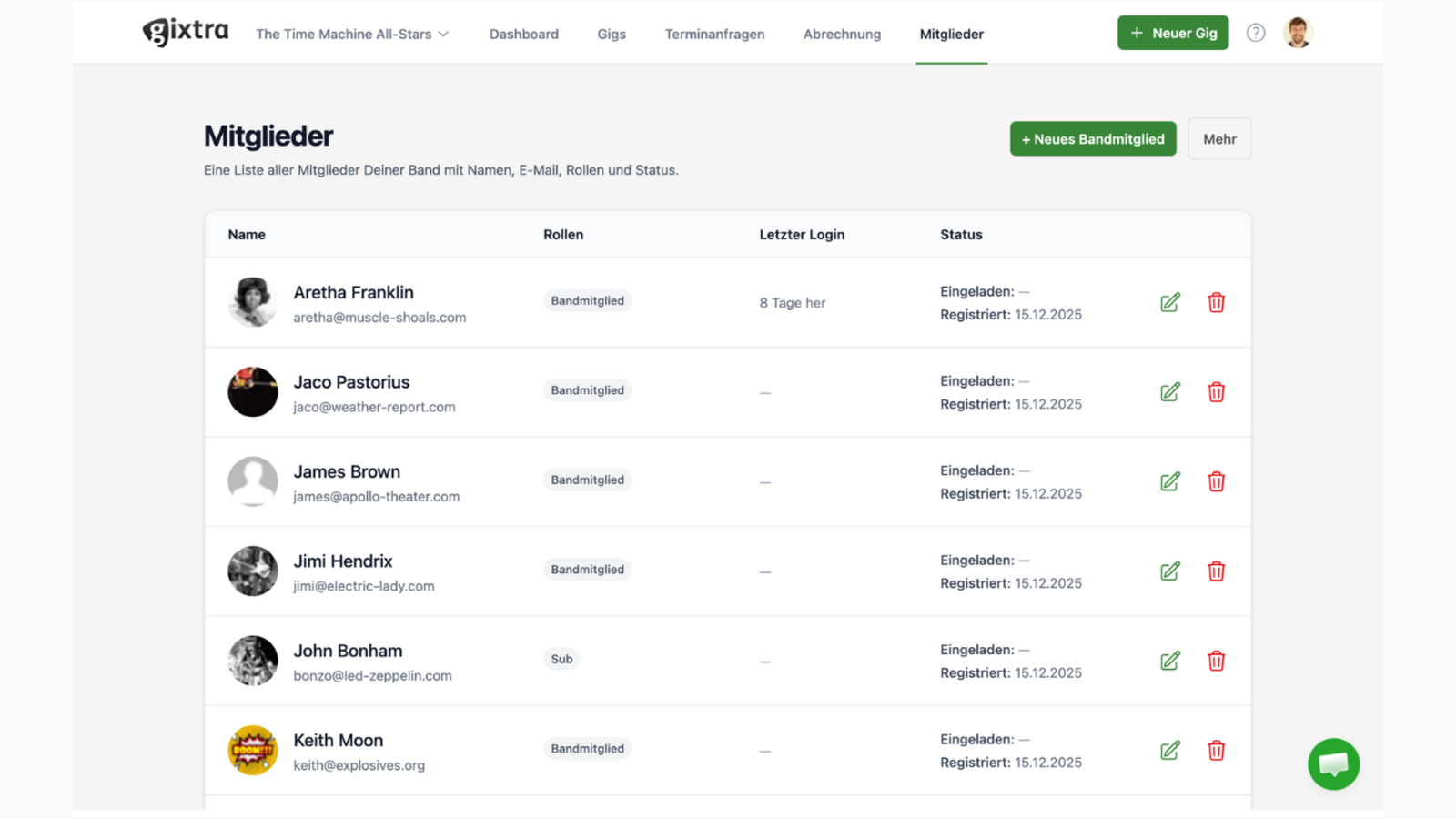
A large musician pool does not solve a line-up problem by itself. For the next gig, you do not need any available drummer. You need someone who can cover this band job, handle the material, accept the terms, and receive enough information to arrive prepared.
In a Musiker-Board discussion about replacing band members, one booker describes a simple principle: know the line-up before confirming the engagement. Other musicians in the same discussion distinguish carefully between replaceable positions and roles where arrangements, technology, or the public identity of the act make a change difficult.
A musician pool is therefore not an address book. It is a prepared answer to three questions: Who fits each band job? Who should you ask first? What does that person need to accept confidently and perform the gig well?
Organise people by band job and actual fit
Do not begin with one ranking of every musician you know. For each job that regularly needs cover—drums, bass, keys, lead vocal, horns, or technician—identify who can handle it in each of your formats.
Look beyond the instrument:
- Do they know the repertoire, or can they prepare it in the available time?
- Can they handle your tracks, clicks, medleys, and live changes?
- Do they fit the engagement: wedding, corporate function, club, or festival?
- Can they provide or safely use the required equipment?
- Is the journey practical for this date?
- Does your agreement with the client allow this position to change?
That last question matters. A function band with a flexible rhythm section may be sold differently from an act whose named singer or soloist is central to the offer. The Musicians' Union's current legal guidance for function bands using deps warns bands to clarify the client's expectations and the relationships involved. The specific law depends on the engagement and jurisdiction, but the practical question is universal: does the replacement line-up still deliver the act you promised?
Set an asking order for each band job
If every decline sends you back through old chats, previous gigs, and contact lists, the pool is not ready to use. Keep a short, current order for each band job:
- Who is normally your first call for this job?
- Who is the next suitable substitute?
- Who fits only under certain conditions, such as an extra rehearsal or a reduced programme?
- Who should be removed because their contact, repertoire, or availability is no longer current?
The order is not a public rating of artistic worth. It answers a practical question for one act. The first call for a club date may not suit a gala with a fixed horn arrangement.
Gixtra Sub lists store exactly this: one reusable asking order for one band job. Select a Drums Sub list when staffing a gig, for example. Gixtra starts with the first eligible person, advances after a decline or expired offer, and stops once someone accepts. People later in the order are not contacted unnecessarily. Sub lists explained shows the full workflow.
The concrete gain is simple: you do not rebuild the same order under pressure for every gig or place several musicians on parallel holds when only one position is open.
Give the musician enough information to accept the real job
“Are you free Saturday?” is not enough, even for a regular dep. The Musicians' Union guidance for depping at live gigs recommends confirming the date and fee in writing and clarifying timings, location, equipment, dress, contacts, and music.
A useful first offer includes:
- date, location, and likely call;
- type of gig and expected role;
- fee, travel arrangement, and who will pay;
- rehearsal requirement and date, if any;
- programme size and realistic preparation load;
- equipment to bring and backline supplied;
- reply deadline and current status of the engagement.
Unknown details can remain open, but label them. Someone who accepts “an evening gig in Cologne” and later discovers an early-afternoon PA load-in and next-morning return journey did not accept the same job you eventually delivered.
Hand over the actual gig after acceptance
Once the position is filled, preparation begins. A song-title list is often insufficient. The substitute needs your versions, keys, medleys, starts and endings, parts, track contents, and current set list. Define the scope before acceptance, then hand over the material this line-up will actually use for the gig.
The actual engagement also needs:
- arrival, load-in, soundcheck, performance, and finish times;
- navigation address, access instructions, and contact;
- dress code;
- backline, stage plot, and technical rider;
- changes from the usual show;
- who makes musical and production decisions.
When these details are maintained on the gig in Gixtra, a confirmed substitute can see the current information permitted by their roles instead of reconstructing it from an old set list, forwarded email, and chat screenshots. That makes the handover quicker and reduces the risk of preparing the wrong version or time.
Prepare for cancellations without treating people like spare parts
A good asking order still needs fair rules:
- Treat an acceptance as a commitment and confirm it on both sides.
- Clarify who may find the substitute and who is responsible for payment.
- Do not secure a dep and then drop them without warning because the regular becomes free.
- Recheck the engagement shortly before the date, even with a regular dep.
- Keep Sub lists current when someone stops working with the band or no longer covers that job.
If a running Sub list no longer fits the gig, the Gixtra booker can stop it or skip the current person and take over manually. The order supports the booker's judgement; it does not replace it.
Different bands need different staffing logic
An agency or bandleader may work with the same musician across several acts. That does not make the asking order universal. A jazz quartet, ten-piece party band, and acoustic trio sell different line-ups and require different preparation.
Record for each band:
- the jobs that regularly need cover;
- the positions that are central to the promised public identity;
- the substitutes who know that act's material;
- the fee and travel arrangement for the gig;
- the current preparation material and its owner.
In Gixtra, each Sub list belongs to one band and one band job. “Chris plays keys” therefore does not silently become “Chris is the first choice for every keys setup in every act.”
Checklist for a pool that is ready to use
- Is there a short, current asking order for each job that often changes?
- Does the order account for repertoire, format, equipment, travel, and client expectations?
- Before accepting, does the substitute know the date, place, call, fee, travel, and preparation load?
- Is it clear in writing who engages and pays them?
- Are the set list, versions, keys, tracks, and production information current?
- Where relevant, does the client know what line-up changes are permitted?
- Are declines, expiries, and acceptances visibly closed?
- Can the booker change, skip, or stop the sequence when the actual gig requires it?
A good musician pool cannot promise to solve every cancellation in minutes. It means that when a band job opens, you know who to approach fairly and appropriately—and that an acceptance becomes a prepared line-up.
Keep the lineup and gig details together
Gixtra shows who is playing, what is still open, and which details apply to the gig.