Blog
How to Check Band Availability and Get Clearer Replies Faster
An empty calendar is not a gig confirmation. Send enough detail, set a useful deadline, and collect a clear yes, no, or maybe for the actual engagement.
An empty date in a shared calendar does not mean a musician can and will play the gig. A work trip may be missing, the journey may not be practical, or the fee may not cover the commitment. The calendar is a useful first filter. You still need an explicit reply to the actual gig before you can confirm a line-up.
In a Musiker-Board discussion about planning a large band, one musician describes the valuable part of a shared calendar: the booker could see known absences without starting a telephone chain for every inquiry. The same case shows the limit. If holidays, work travel, or family commitments are not entered, an apparently free date creates false confidence.
Faster replies do not come from applying more pressure. They come from making the offer answerable, defining what each reply means, and keeping outstanding decisions visible.
Make the offer answerable before you send it
“Can you do 14 September?” is quick to send and difficult to answer properly. A local club date may be an easy yes while a wedding on the same date involves an early load-in, a long drive, and a night away.
A current Musiker-Board discussion about booking inquiries identifies place, date, time commitment, production, and fee or budget as useful first details. Your internal availability check should include at least:
- Date and place: Enough information to judge the outward and return journey.
- Type of engagement: Wedding, festival, club, corporate event, or another format.
- Likely call: Approximate load-in, soundcheck, performance, and finish times.
- Role: The band job you are asking that person to cover.
- Fee and travel: What is agreed and what remains open.
- Status: An initial inquiry, an option, or a confirmed engagement.
- Reply deadline: When the client, promoter, or agency needs your decision.
Not every detail is known at the first check. Say so. “Soundcheck time still to be confirmed” is more useful than omitting time completely. The musician can include that uncertainty in their decision instead of discovering an extra half-day after accepting.
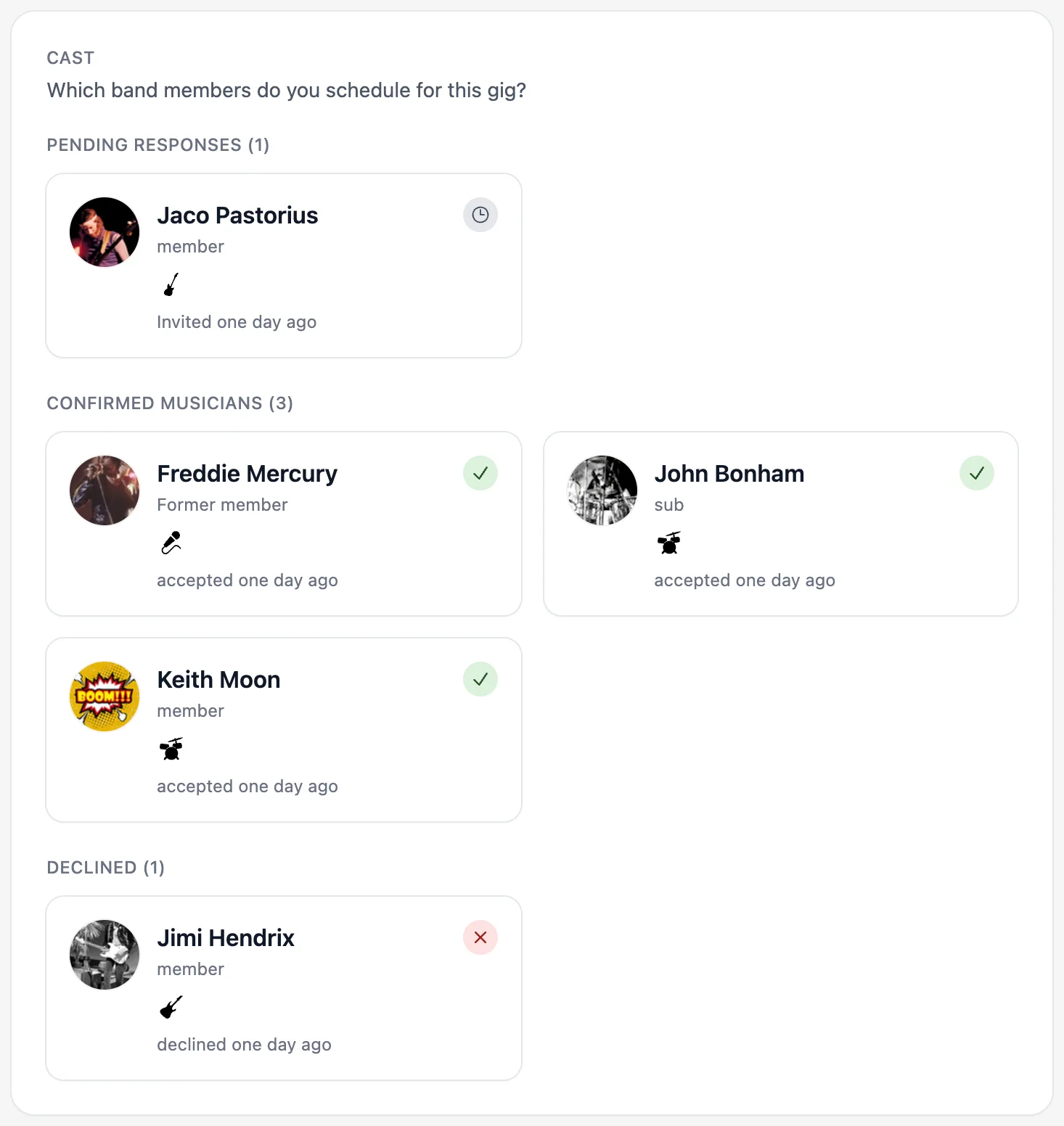
In Gixtra, these details stay with the gig. Everyone is therefore replying to the same offer rather than to chat messages with different versions of the facts. The practical gain is more than changing the input channel: the booker can see the requested line-up beside the information those musicians used to decide.
Separate a calendar conflict from a gig reply
A maintained absence calendar can prevent pointless offers. It answers one question: “Is there already a known conflict?” It does not answer: “Has this musician accepted this engagement?”
Use two separate steps:
- Pre-check: Is there a known conflict on the date?
- Decision: Does the musician accept, decline, or need more time for this gig?
When a musician connects a private calendar, Gixtra can warn the booker about a possible conflict without showing the private event details. That warning deliberately does not accept or decline the gig. The musician still decides whether the event truly clashes and whether the engagement works.
This also avoids the opposite mistake. Someone may have a private event in the morning and still be free for an evening show. Treating every busy marker as unavailable would mislead the booker just as much as relying on an incomplete calendar.
Three replies work—if “maybe” has a next step
A thumbs-up, reaction, or “should be fine” is not a dependable line-up decision. Use three distinct replies:
- Attend: I can and will play this gig on the stated terms.
- Not attend: I cannot or do not want to take this gig.
- Maybe: One specific open question prevents a decision.
A useful maybe includes the reason and a decision time:
I am waiting for next week's rota. I can give you a definite answer by noon on Friday.
“Maybe” without either detail simply transfers the uncertainty to the booker. Gixtra records a reason with a maybe reply, so the booker can see both the uncertainty and when follow-up makes sense. Reply to a gig offer explains the participant workflow.
Set the deadline from the real decision pressure
There is no universal reply window for every gig. In a discussion about line-ups and substitutes, one musician describes their band's 24-hour rule. That is a real working example, not an industry standard.
Work backwards instead:
- When does the client need your answer?
- How much time will you need to ask a substitute after that?
- What information do the musicians need for a fair decision?
- When must a maybe become a final answer?
A well-described last-minute offer may reasonably need an answer that day. A date next year with unresolved holiday plans may need longer. Give a specific date and time rather than “ASAP.”
Gixtra gig offers can have an expiry. Pending musicians can receive a reminder before it, and an unanswered offer becomes a decline when the deadline passes. Silence cannot accidentally turn into acceptance or block the rest of the line-up indefinitely. You still choose a deadline that fits the gig; Automatic offer expiry explains the behaviour.
Follow up only where a decision is missing
A whole-band message asking “Who hasn't replied?” makes everyone reopen a decision, including people who already answered. Use a short status check instead:
- Who has not replied at all?
- Whose maybe has a stated decision time?
- Which band job is still unfilled?
- Who will you approach next if an answer does not arrive?
Gixtra shows the reply states on the gig. Automatic reminders go to people whose reply is still missing or still maybe instead of messaging the whole band again. This reduces messages, but the larger advantage is dependable checking: a reply in email, chat, or rehearsal cannot be overlooked while another list incorrectly shows a complete line-up.
Close the availability check visibly
Once the line-up is complete—or the gig falls through:
- confirm who is actually playing;
- release outstanding offers and options;
- communicate material changes directly;
- keep the current gig status visible to the participants;
- send the same complete details to the next suitable substitute after a decline.
That final step is easier when you do not start searching from scratch. A maintained asking order for each band job lets you approach the right people without messaging the entire musician pool. How to organise a musician pool and staff gigs with substitutes covers that workflow.
Quick availability checklist
Before sending the offer, check:
- Are date, place, event type, and approximate call stated?
- Is the band job and financial arrangement clear enough to decide?
- Does everyone know whether this is an inquiry, option, or confirmed gig?
- Is there a specific reply deadline?
- Does attend mean accepting the described engagement?
- Does a maybe include a reason and decision time?
- Can you see missing replies without reconciling several channels?
- Do you know when to move to the next substitute?
When those points are clear, musicians do not need to type faster. They can decide faster because they know what they are deciding about.
Fictional demo band image credits: cropped avatars by Carl Lender (CC BY 2.0), Dina Regine (CC BY-SA 2.0), A. Vente (CC BY-SA 3.0 NL) and Pino alpino (public domain). Illustration: Designed by Kreativkolors / Freepik.


Keep the lineup and gig details together
Gixtra shows who is playing, what is still open, and which details apply to the gig.