Blog
Band Fees and Travel Expenses After a Gig: A Practical Workflow
Agree the fee, travel model, payer, and payment date before the gig. Afterwards, collect the actual figures, check the settlement, and track what remains unpaid.
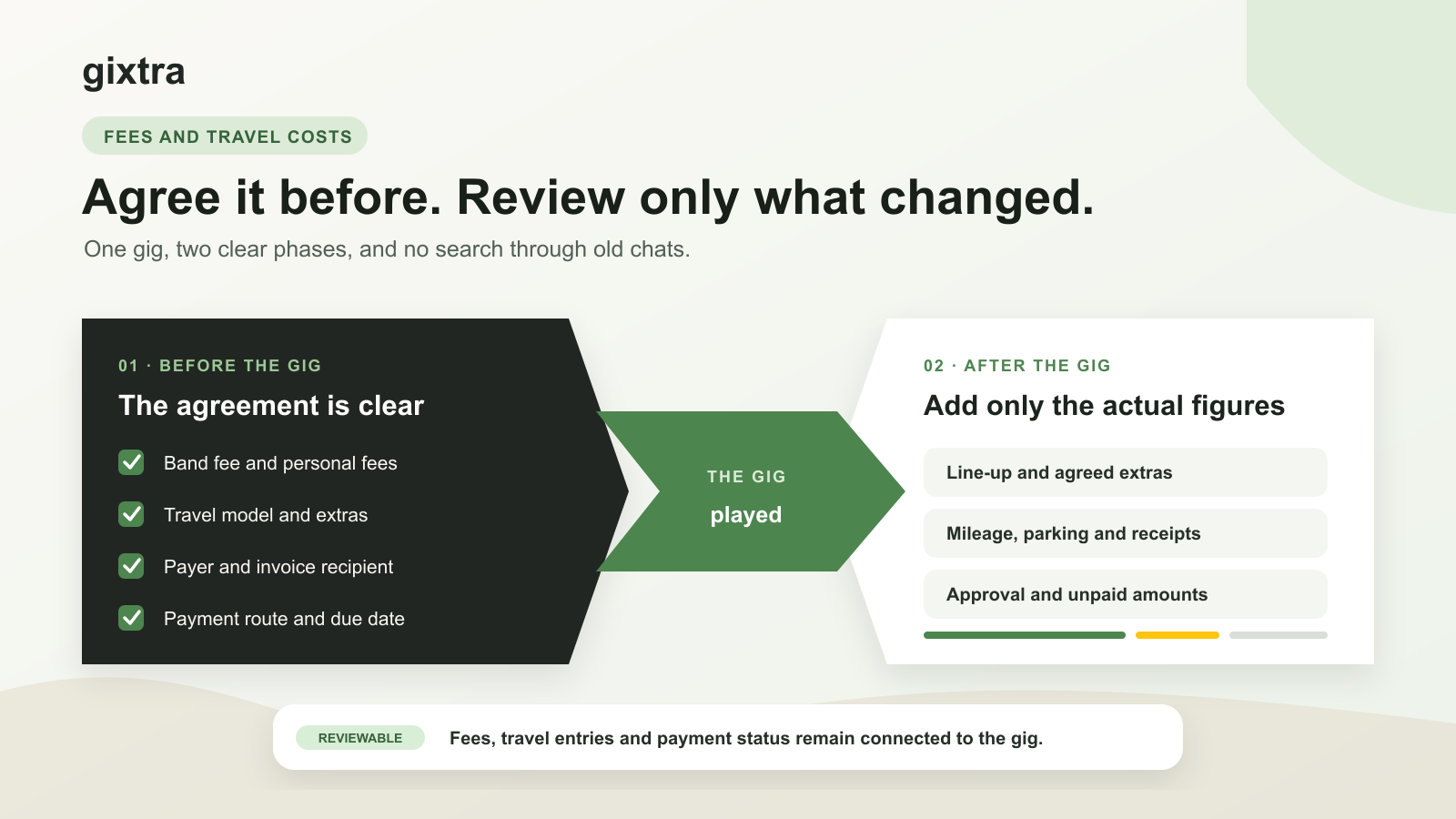
After the gig is too late to guess whether travel was included in the fee. That is when awkward messages begin: Was the long journey part of the quote? Who gets an individual fee? Is a parking receipt missing? Does the band pay its musicians now or after the client pays?
In a Musiker-Board discussion about charging for fuel, working musicians and organisers describe different viable models. Some include travel in one total price; others show it separately. The discussion does not establish a universal mileage rate. It demonstrates a more useful principle: agree the model before the gig so the client, band, and musicians expect the same figures.
A dependable workflow separates two agreements. First, what does the contracting party owe the band? Second, what does the band or bandleader owe the musicians and technicians it engaged?
Agree the settlement before confirming the gig
The external agreement should identify:
- Who contracts the band, and who will pay?
- What is the agreed performance fee?
- Are travel, parking, tolls, accommodation, and meals included or additional?
- Is travel charged at an agreed flat or mileage amount, or reimbursed at actual cost?
- What performance, setup time, and possible overtime does the fee cover?
- How and when will payment be made?
- Who receives the invoice, and does it need a purchase order or project reference?
The Musicians' Union's current live engagement contract guidance recommends confirming the essential terms in writing. Its templates and law are UK-specific, but the operational reason travels: date, place, times, fee, and travel should not depend on memory when it is time to invoice.
Inside the band, make a second agreement:
- Does everyone receive the same share or an individual fee?
- Are rehearsals, production, transport, or booking paid separately?
- Which travel costs will the band reimburse to each person?
- Who can approve expenses?
- Who checks that all figures are complete?
- When are musicians paid, and must they submit an invoice?
The external price and internal distribution are not the same thing. A client may pay one total band fee while the band uses it to cover musicians, production, transport, and band funds according to its own agreement.
Choose a travel model everyone can understand
Three broad approaches appear regularly in gig work. None is automatically correct for every band.
| Model | What must be agreed | Common problem |
|---|---|---|
| Included in the total price | The journey covered by the quote | A later line-up or vehicle change consumes the margin |
| Agreed flat or mileage amount | Distance, vehicles, return journey, and included extras | Band and client calculate different distances or vehicle counts |
| Actual costs | Eligible receipts and any approval requirement | Parking, rail, hotel, or toll costs appear after the gig without agreement |
The internal model can differ from the client quote. The band might sell one fixed price while reimbursing its driver at an agreed rate from band funds. That is workable when both sides of the calculation are documented.
Do not copy a mileage figure from a forum or tax page and treat it as the sale price for every gig. A tax deduction, reimbursement by the band, and the price charged to a client are separate questions. Where legal or tax treatment matters, obtain advice and reflect the answer in the agreement rather than estimating it afterwards.
Record only the actual changes after the gig
When the agreement is clear, the post-show work is short. Check:
- Which line-up actually performed?
- Was there agreed overtime or another additional service?
- Who drove, and who shared a vehicle?
- Which parking, toll, rail, or hotel costs qualify under the agreement?
- Are receipts or mileage entries missing?
- Has the invoice recipient or required reference changed?
An unexpected cost is not automatically chargeable to the client. If the band needed an extra taxi or travelled in another vehicle, check the agreement and resolve disputed amounts before sending the invoice.
Gixtra can keep the agreed fee on the gig and store individual participant fees when amounts differ. That removes the later search for “What did we promise the substitute?” across old messages. With individual fees, each participant sees their own amount; Who can see fees and expenses? explains the access rules.
Collect travel entries where the settlement is checked
Set one internal cutoff for travel entries or receipts—for example, before the next scheduled payment run. A named person then checks what is missing. Without that closing point, every gig remains an open memory task.
When travel expenses are enabled in Gixtra, musicians enter their own figures after the past gig. They cannot see everybody else's expenses, while an Accountant can review them across the band. A notification can prompt missing entries after the gig. The person settling the show no longer needs to message everybody separately and reconcile answers from several chats. Add travel expenses after a gig explains the musician's step.
An entry does not make an amount correct or reimbursable by itself. It gives the responsible person one complete list to review instead of first discovering who intended to claim something.
Separate payouts, invoices, and incoming payment
Three processes may run in parallel after the show:
- The band invoices the client or receives the agreed cash payment.
- Participating musicians may invoice the band or bandleader under their own engagement.
- The responsible person pays approved fees and travel, then tracks anything outstanding.
Who invoices whom depends on the real contractual and employment relationships. Do not automatically treat every substitute as a band partner or every regular member as a self-employed contractor.
For supported gigs, Gixtra can bring the stored fee and existing travel description into an editable musician-invoice draft. Finalised invoices give the issuing musician and receiving band a shared payment status. This reduces duplicate upkeep across a document template, gig list, and separate paid/unpaid sheet. The people involved still review the figures and applicable tax treatment.
A workflow that still works on Monday
Before the gig
- Confirm the contracting party, payer, total fee, and payment method in writing.
- Agree the travel model and included extras.
- Decide internal fees, expense rules, and responsibilities.
- Collect the invoice address and required references.
Directly after the gig
- Check the actual line-up and agreed extra services.
- Collect travel entries and receipts.
- Resolve missing or disputed figures with the relevant person.
During settlement
- Check the external invoice and internal payouts separately.
- Include only agreed and supported items.
- Create and send invoices promptly.
- Keep incoming payments and unpaid musician amounts visible.
The least awkward post-gig settlement starts before the first note. When fee, travel, and responsibility are agreed at booking, there is no expense hunt after the show—only a short, reviewable settlement.
Keep the lineup and gig details together
Gixtra shows who is playing, what is still open, and which details apply to the gig.